
Planting Guides
Planting Perennials
Perennials will usually return year after year. However, selecting and planting perennials takes a little thought and preparation.
-
First, unlike annuals, most perennials will bloom brilliantly for 2-3 weeks. (Many will bloom off and on after the first show.) It is important to take your time selecting plants and asking questions, taking into consideration altitude, hours of sunlight, soil conditions, exposure to wind, etc. See our Plant Pages for details on all these factors.
-
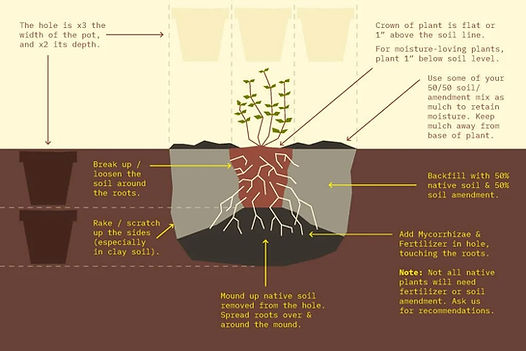
Second, prepare your flower beds by incorporating generous amounts of organic matter, such as compost, top soil, biochar or blends of these. Fertilizing the beds is important in order to get maximum growth, bloom and rooting. Supplement with fertilizer such as a root stimulator or kelp for the first month. You can add a mycorrhizae when planting which will help the roots adapt quicker and is beneficial to the soil. Better yet--pick up one of our Resilient Roots kits for everything your plant needs to thrive!
-
Third, most perennials can be planted on 18″ centers or closer if you are using a ground cover to fill in between pavers or walkway, so as not to compete with their neighbor.
-
Watering new perennials will typically start at 2 times a week to soak the soil, usually a half-gallon to a gallon each. It is key to soak them, this encourages deeper root growth. In the heat of the summer you will probably need to water 3 times a week for the first two seasons. Once the temperatures drop you can move back to 2 times a week, and finally when the plants go dormant you will water one time per month. Perennials will be very drought tolerant after a couple of seasons in the ground.
-
Don't forget your repellents: elk, deer and rabbits tend to like many of the perennials here in Colorado. Elk eat mostly everything and stomp the rest, mule deer browse heavily, rabbits aren't choosey, voles love roots and remember too much fertilizer does not make a perennial grow faster.


Shrub and Tree
Once your tree or shrub has been planted, water it deeply twice per week until established. It could take up to a full year for your new plant to develop a good root system. It is important that you do not let your plant get too dry during this time.
Water Properly:
Water thoroughly until the entire planting area is moist. For foothills soils, this may be 2-3 times per week, 2-3 gallons at a time. Try to avoid water getting on the plant foliage and concentrate water on the ground around the plant base. It is best to use a slow stream with a hose to make sure the water soaks into the root zone.
Fertilize:
The best times to feed your plants are late winter and early spring. The plant may be dormant above ground, but the winter months are the busiest months for root development. The food taken in by the plant during this time ensures it has enough energy to sustain growth during Spring and Summer.
Notes:
Again, do not forget your repellents: elk, deer, and rabbits know their territory and will always test new plants in their territory no matter how deer resistant the plant is supposed to be. Shrub and tree browsing by elk and deer will happen at any point during the year.